Off to Italy again! We planned a 17-day trip to Italy, visiting Sicily and the Amalfi Coast – 3 nights in Palermo, 6 nights in Montevago, 6 nights in Sorrento, and 1 night close to the airport in Rome.
Since we needed to be in Palermo for the start of our escorted tour with Sicilian Encounters, we decided to arrive three days before the tour started to explore the city. Also, I have been experiencing pretty bad jet lag our last few trips, and I was hoping that this would help me get over that before the tour started.
Susan, Sarah, Mr. T, and I flew out of Chicago O’Hare to Frankfurt, Germany, and then on to Palermo. What should have been an easy trip turned into a funny story 😁. Our flight to Frankfurt was leaving O’Hare at 6:30 PM, so we thought we were safe by leaving Springfield around 10:30 AM. Our plan was to stop at our favorite place for lunch, the Old Route 66 Family Restaurant in Dwight. As we were all making idle chit-chat in the car, Sarah makes a comment that the gate for our flight at 3:15 PM has been announced. I’m like “What?! Our flight is at 6:30 PM.” Silence – then OMG! Sarah had booked the 3:15 PM flight to Frankfurt instead of the 6:30 PM flight. Even though there was room on our flight to Frankfurt, we were afraid that if she missed her first flight they might cancel her second flight to Palermo. So, I “put the pedal to the metal”, gave her curbside service, and she made it to her gate with 15 minutes to spare. Whew! She had a long layover in Palermo, and we joined her there after a few hours.
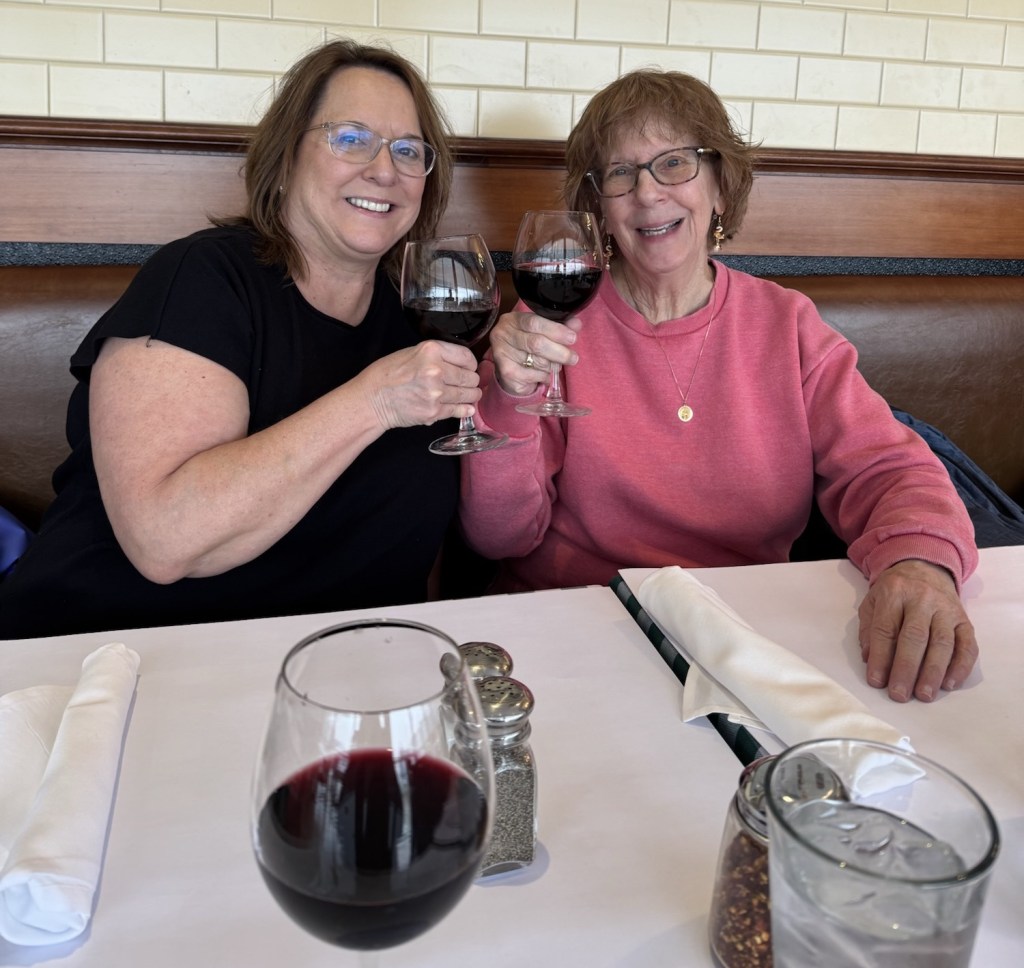
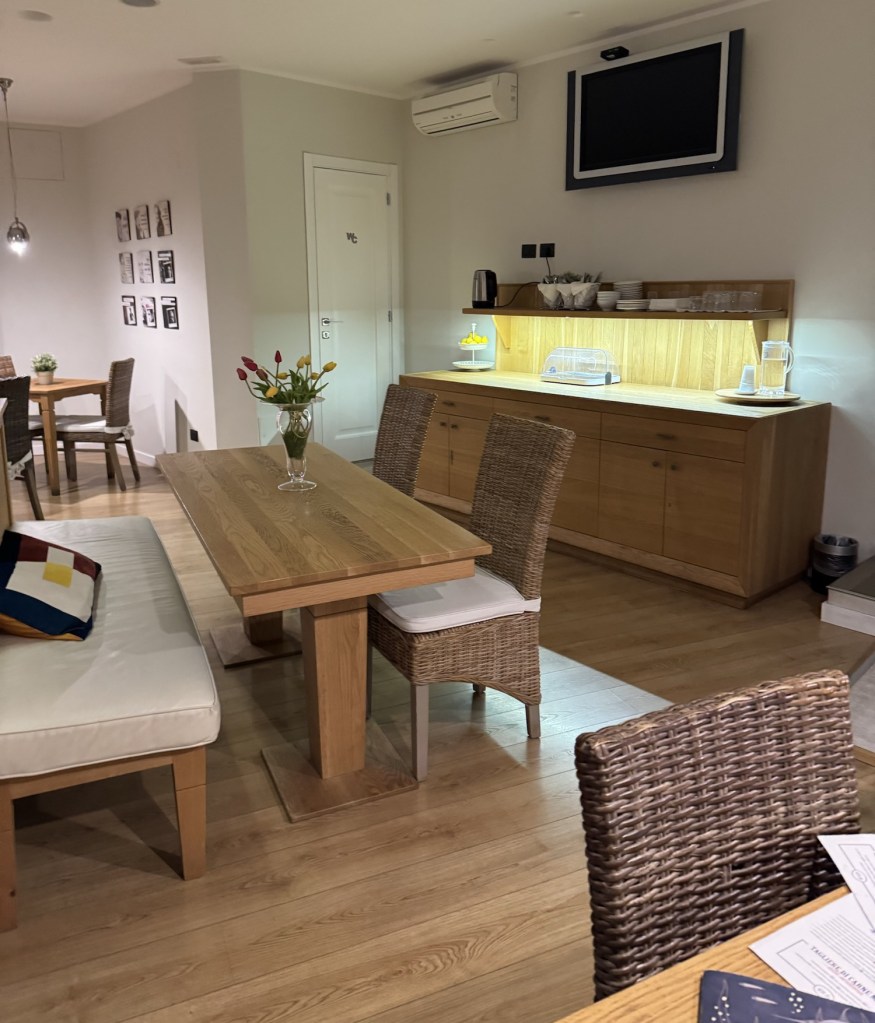
There were several of us (Zach, Nancy, Laura, DLP, Rick, Pat, and Sue Woo, plus me, Mr. T, Susan, and Sarah) who had decided to spend a few days in Palermo, and we all stayed at Delle Vittorie Luxury Rooms & Suites. This Bed and Breakfast is very quaint, situated on a floor in an older building that has been rehabbed. I believe there are only seven or eight rooms, and our group had six of those rooms. What I would call the “lobby” and “breakfast room” had several tables for us to gather around in the morning and when we got back after a day of adventures.

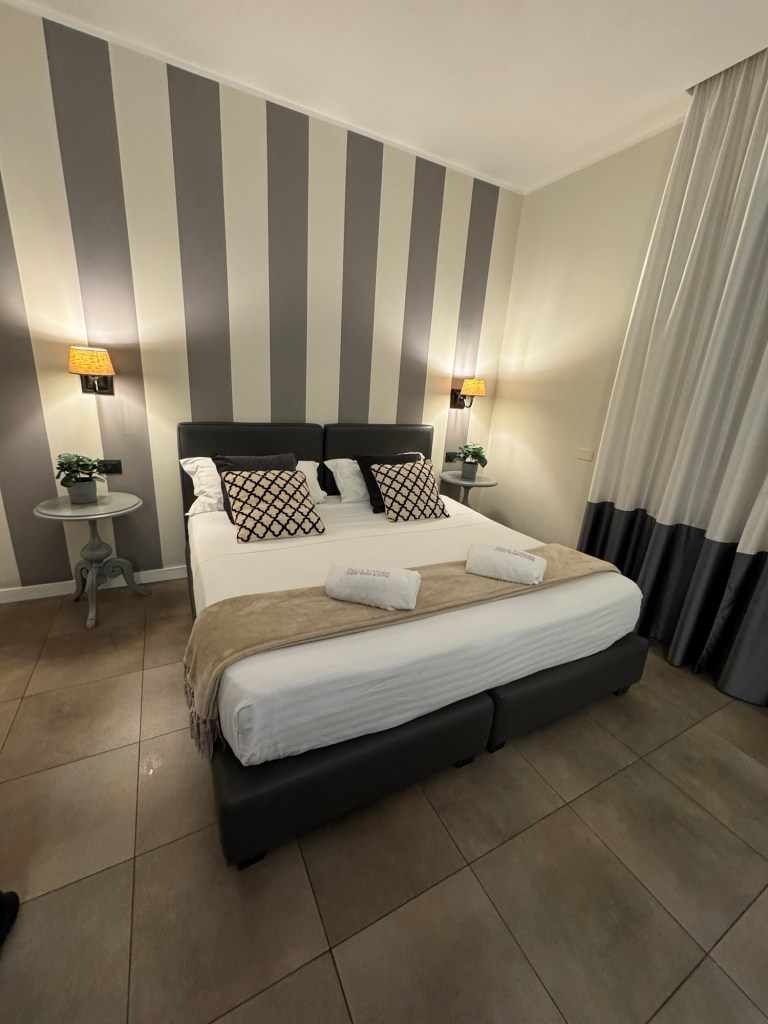
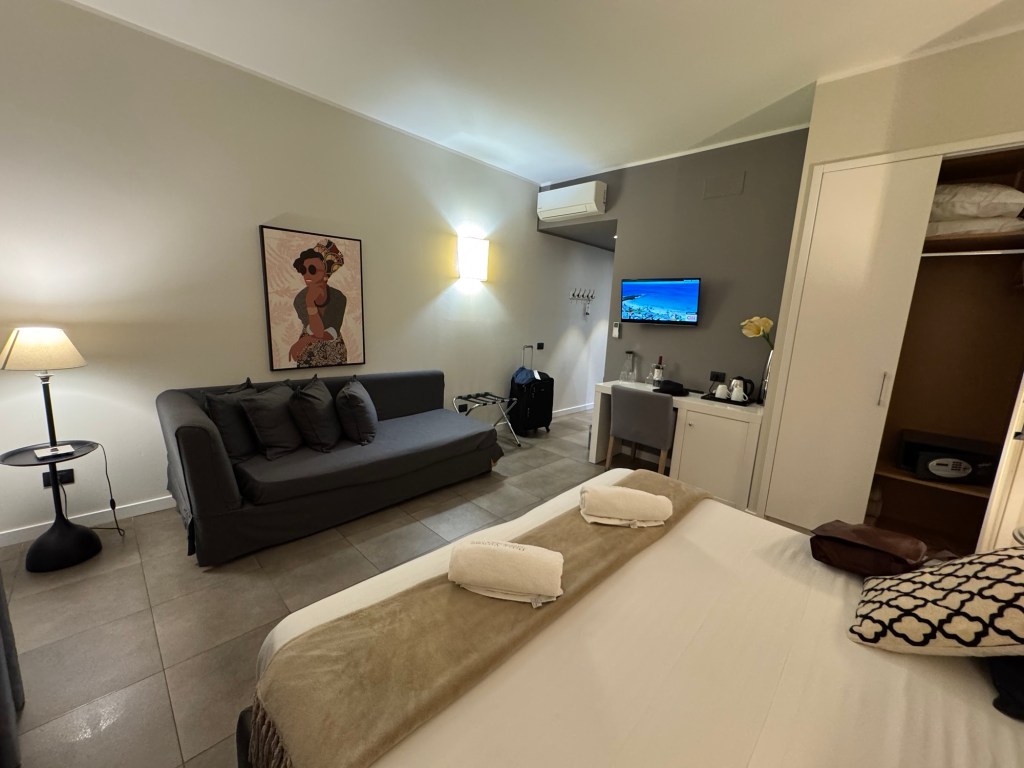
Since we didn’t arrive to the hotel until around 7:00 PM we had no trouble getting into our room. We were exhausted and just wanted to get something to eat – but not too heavy. Just outside of the hotel is a street full of restaurants and bars, and we chose to eat at Donna Franca Lab for some gourmet arancine and delicious desserts – it was exactly what we were looking for. Arancine (or arancini) are Italian rice balls, stuffed with cheese or meat (or really anything), coated in breadcrumbs, and deep fried. And even though you can get them throughout Italy, arancini are a traditional Sicilian dish, originating in the 10th century when Sicily was under Arab rule. They are delicious and very filling!
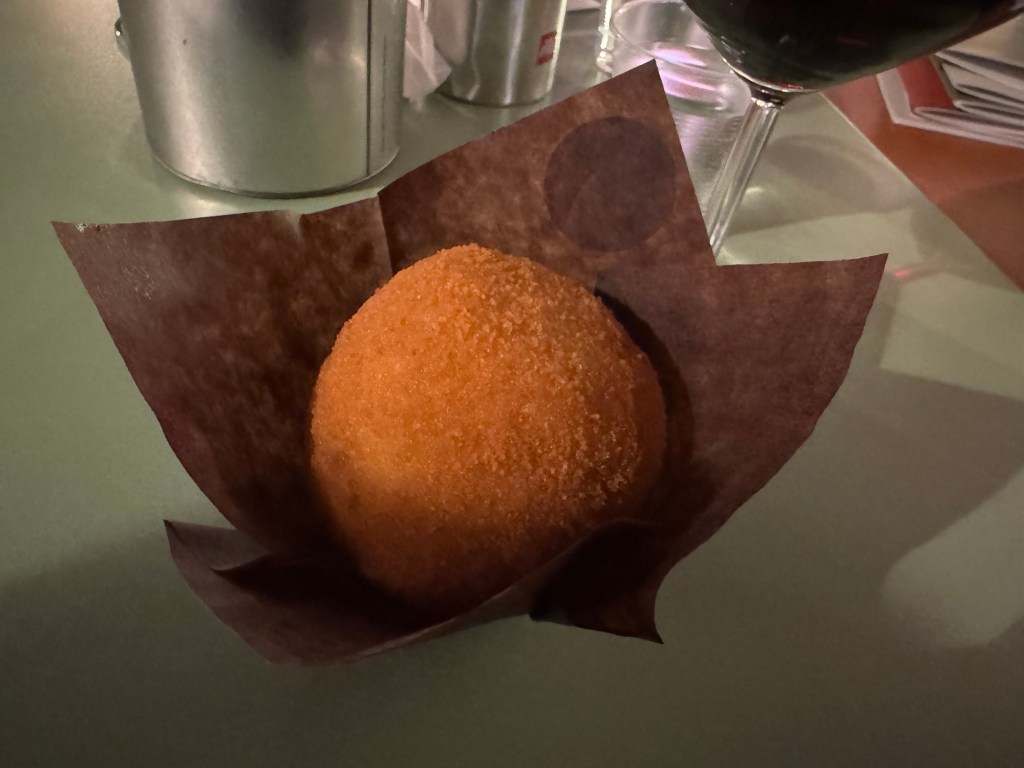

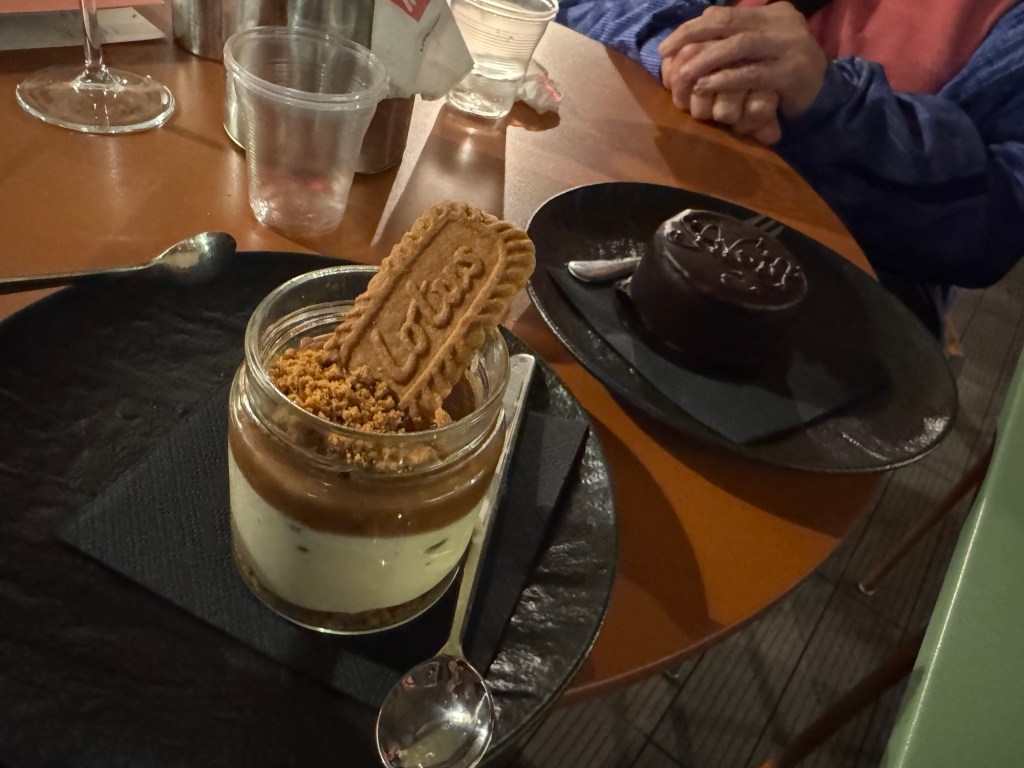
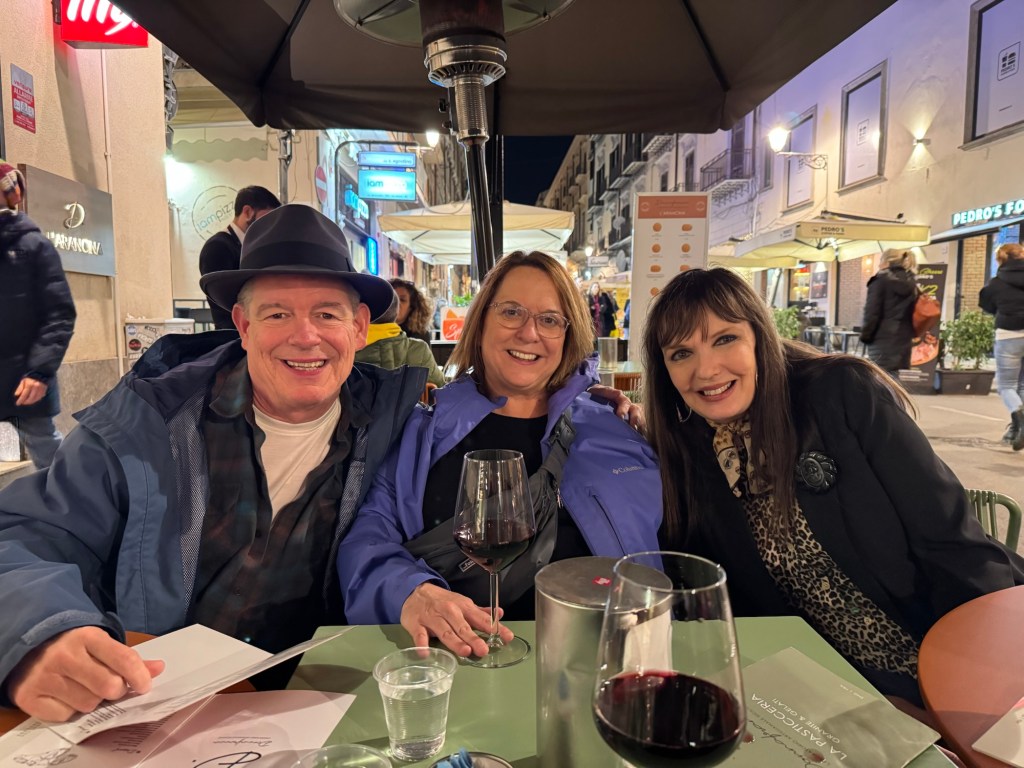

The next morning we had booked a tour with a local guide named Fabio through the website Withlocals. It was a rainy day, which we found out later from Fabio that when it rains, Sicilians do not venture out. We could tell by the number of people on the streets! But the rain didn’t bother us Midwesterners at all 😊.

The first thing Fabio did was give us a little history lesson about Sicily. Sicily has been ruled by the Greeks, Romans, Arabs, Normans, and Spanish before being unified with Italy in 1860, and you can still see the influence each of these cultures had on the island in their architecture and food.
We started at Porto Nuova, the monumental city gate located next to the Palazzo dei Normanni, the Royal Palace of Palermo. This building is the oldest royal residence in Europe, and was first occupied by the Norman King, Roger II. I don’t why, but the king’s name struck me as funny 😁.
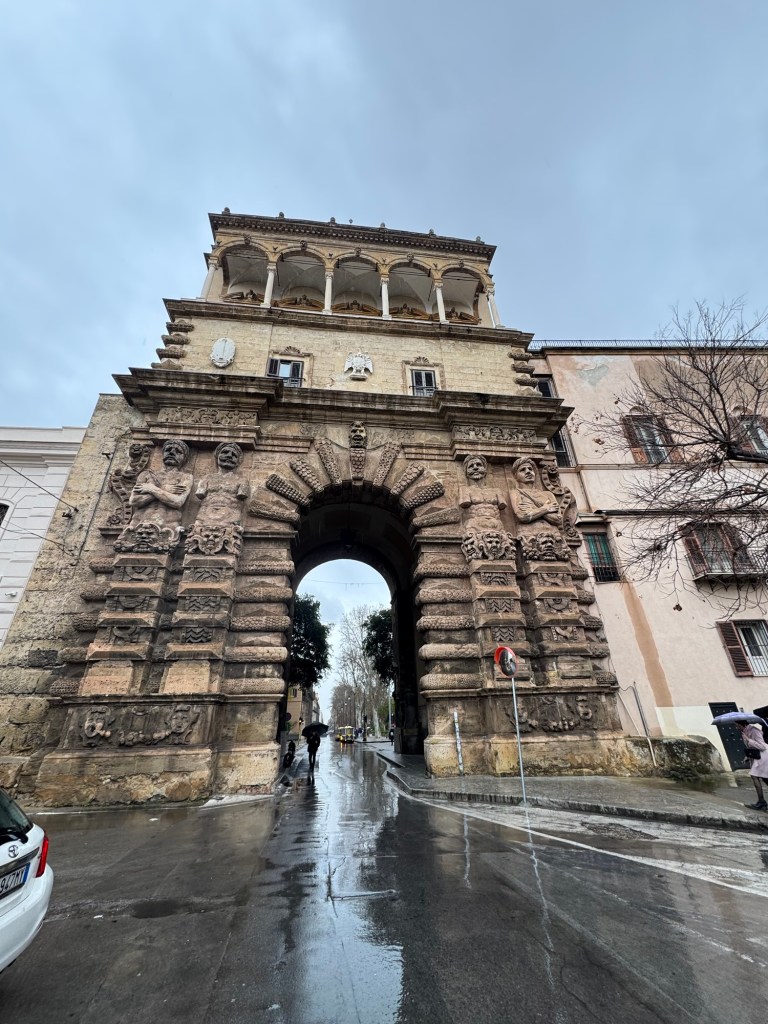
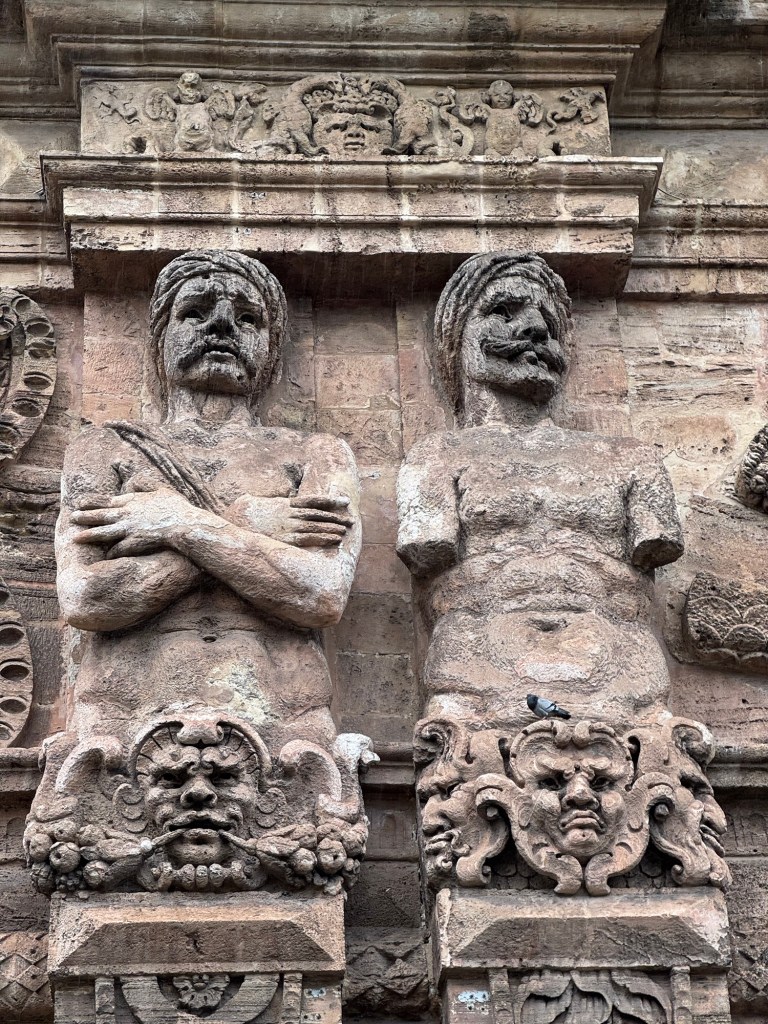
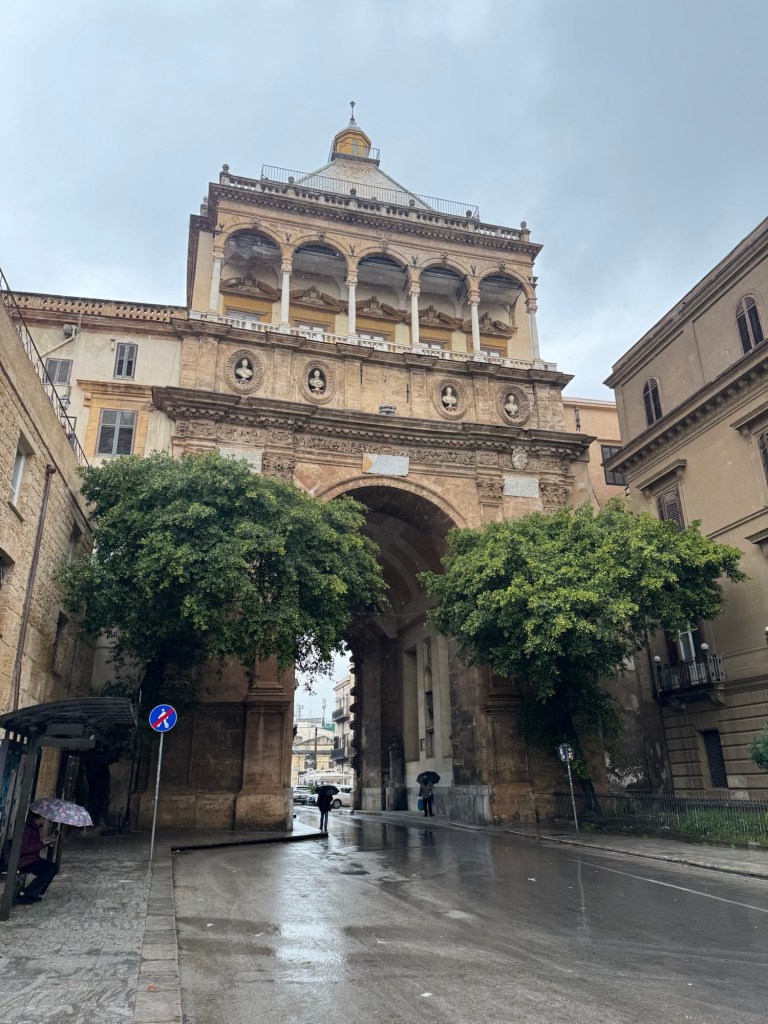

Our next stop was the Palermo Cathedral, erected in 1185 by the Norman Archbishop on the site of an earlier Byzantine basilica, which had later turned into a mosque when the Arabs conquered the city. The outside is majestic and you can see the combination of Norman and Arab influences in the architecture and details of the building.


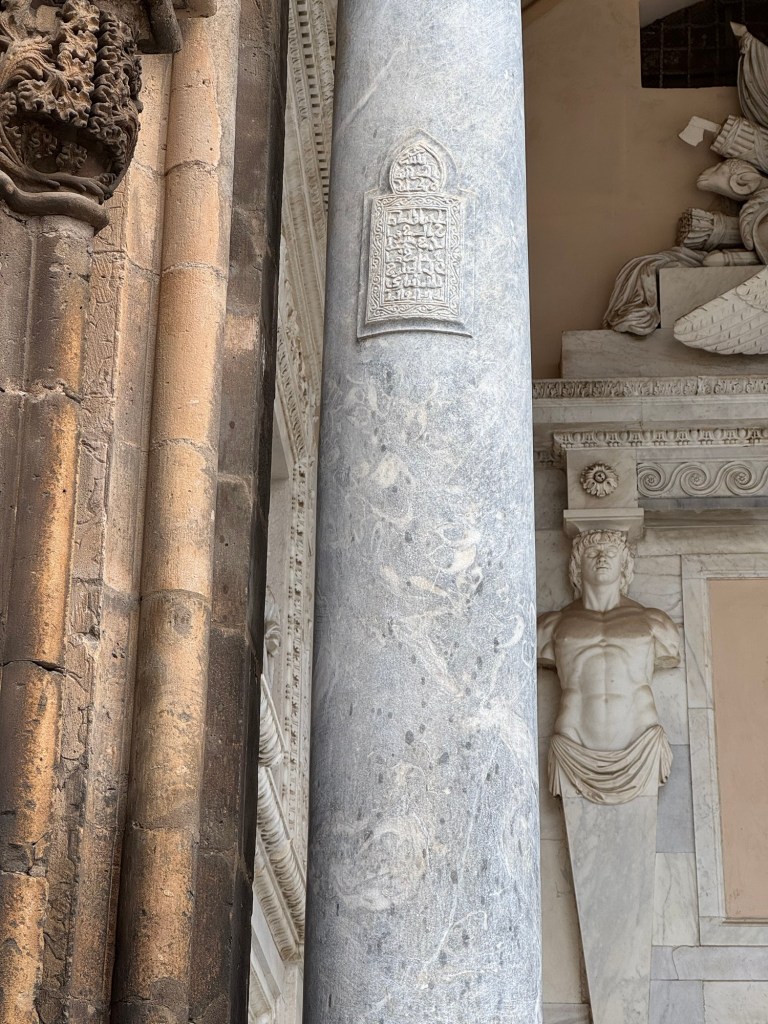
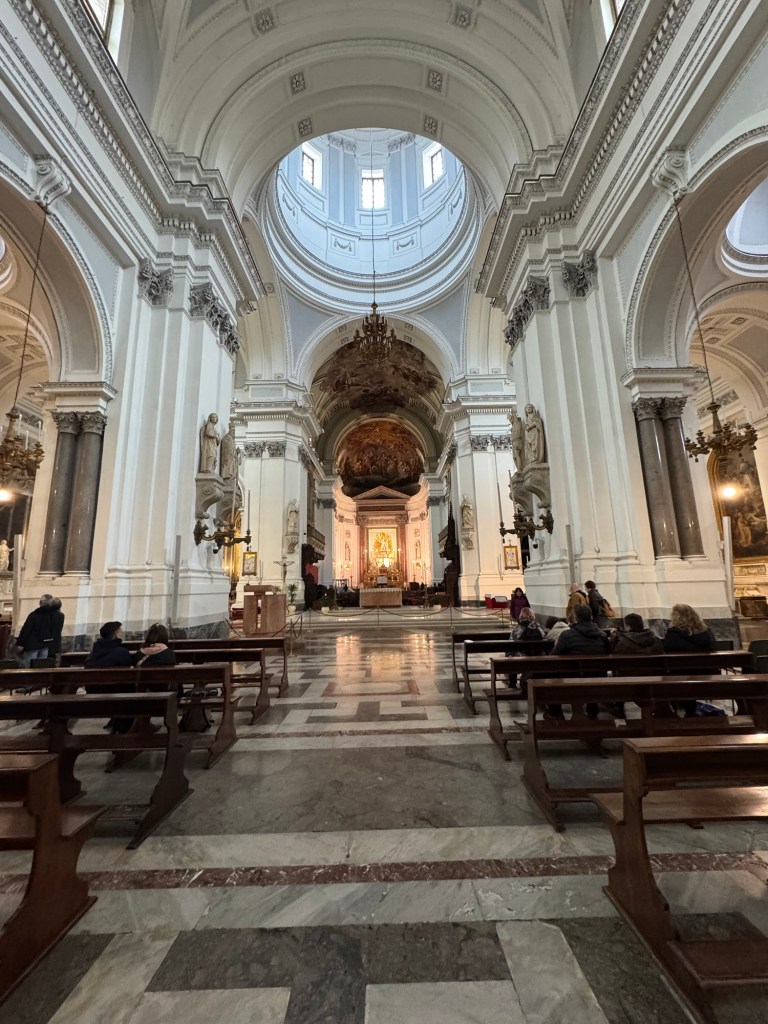
One of the neat things about this cathedral is the “solar observatory” called a heliometer which measures not time but months. There is a pinhole in the ceiling of one of the domes for the sunlight to come through and the pathway of the sun will land on (or close to) a bronze line with different areas labeled by the 12 zodiac signs.

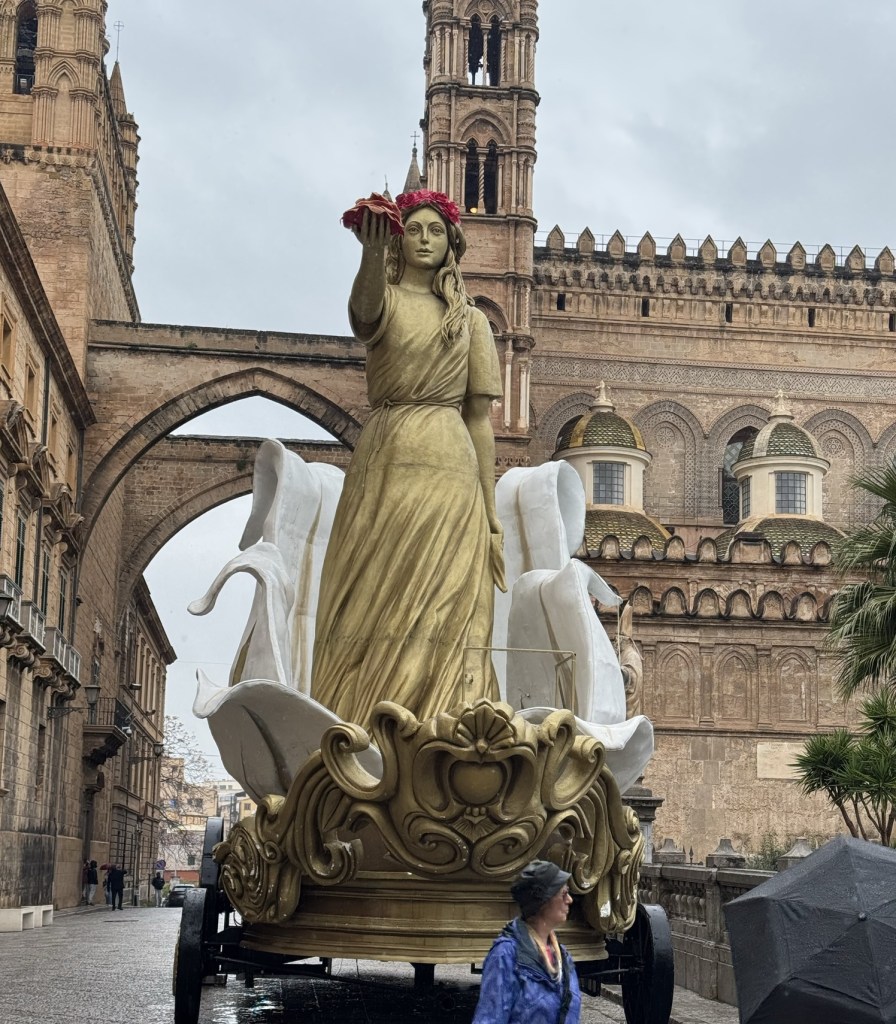
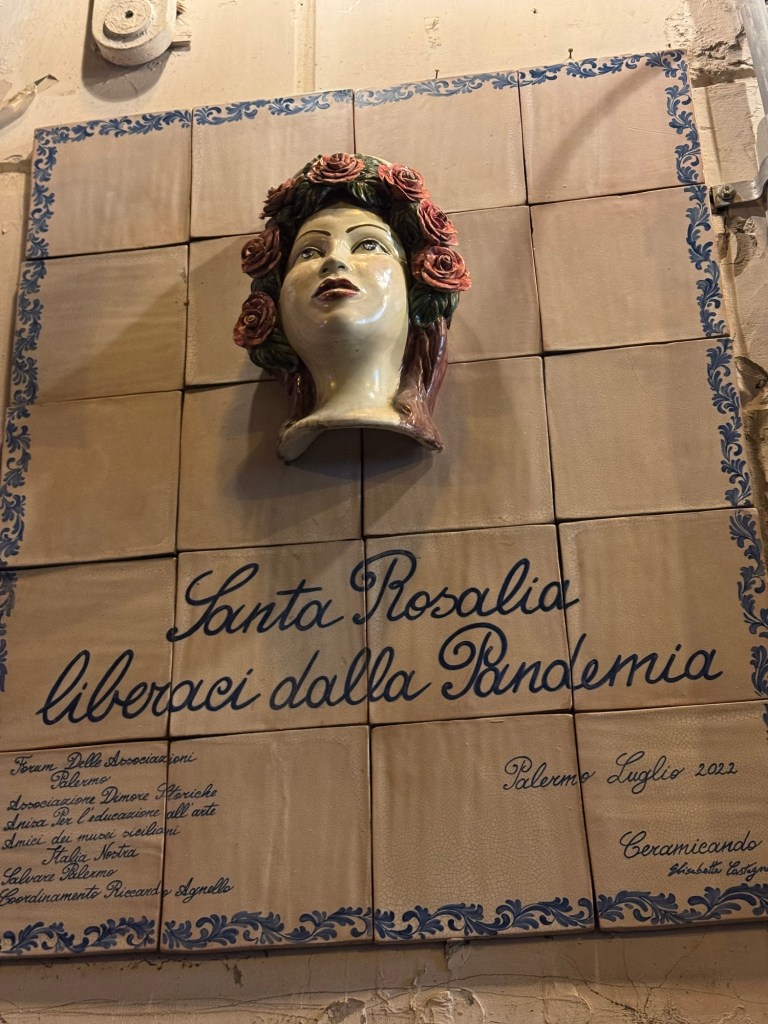
Outside of the cathedral along a side street is a massive statue of the likeness of Saint Rosalia, the patron saint of Palermo. Every year on July 14 – 15 in Palermo there is a festival celebrating Saint Rosalia, and her likeness is paraded throughout the city on a float. The story of how Rosalia became the patron saint of Palermo is also very interesting. Rosalia was devoutly religious, and even though she was born into a noble family, she lived as a hermit and died alone in 1166. In 1624 Palermo suffered through the bubonic plague, and it was during this time that a sick woman and a hunter claim that Rosalia appeared to them, telling them where her remains could be found. They were instructed to dig up her bones, bring them to Palermo, and parade them around the city. After her remains were paraded around the city three times, the plague ended. She is still highly regarded in Palermo, especially since the COVID Pandemic in 2020.
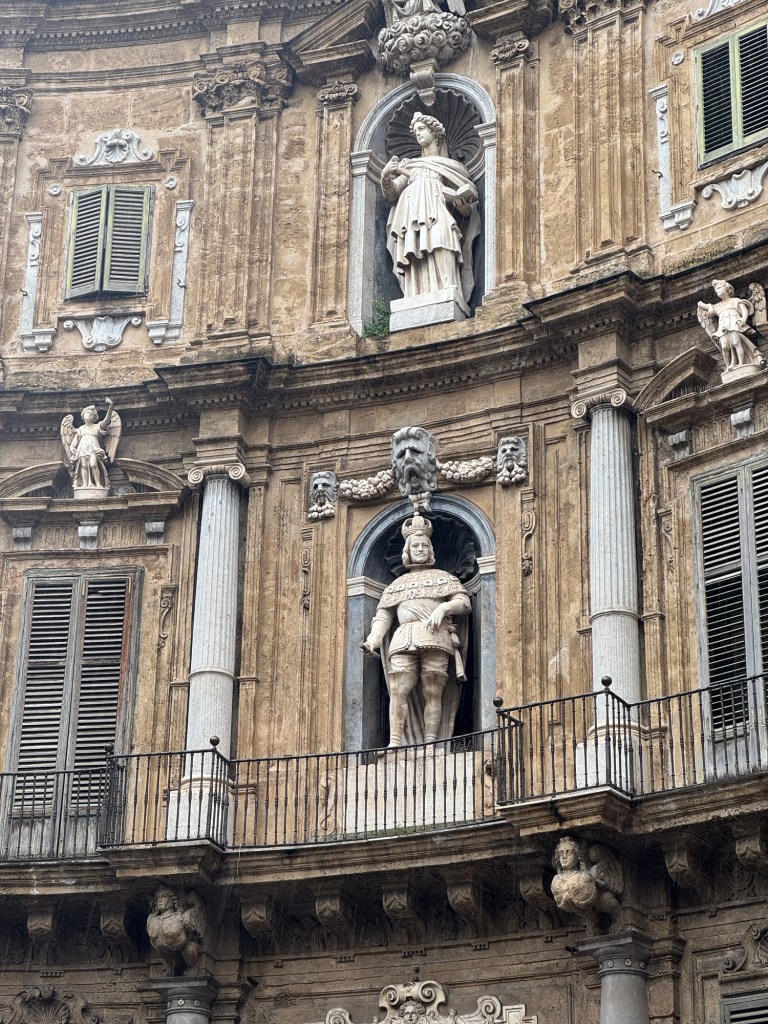
Our next stop was the Quattro Canti (Four Corners), the intersection of two of the major streets in Palermo – Via Maqueda and Corso Vittorio Emanuele. This spot is considered the center of the historical city. On each of the four corners are statues and fountains representing the seasons, the Spanish kings, and four other female patron saints of Palermo (minus Rosalia).

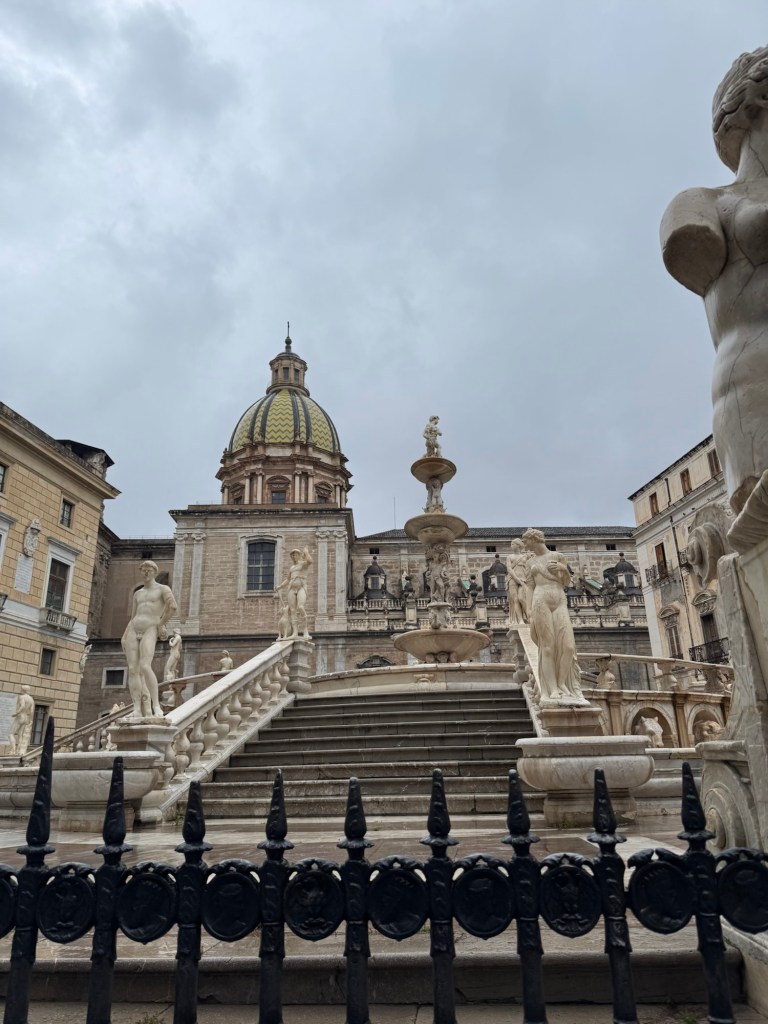
Just around the corner from Quattro Canti is Piazza Pretoria, where there is a large fountain that has been controversial for many, many years. The fountain, Fontana Pretoria, was purchased by the city of Palermo from a man who lived in Florence, and it was installed in the piazza in 1581. Back then, the bigger the fountain, the better, if you wanted to showcase your city’s wealth. The placement of the fountain is in front of the Town Hall, as well as right next to a Dominican Convent at the Church of St. Catherine of Alessandria. Why the controversy? There are lots of statues and in true Renaissance form, they are naked and anatomically correct (wink wink). And the nuns, well, they didn’t like it, and yelled “Che vergogna!” (What a shame!) from the windows. Also, at some point, somebody chiseled off the private parts of the male statues that were facing the convent. So, the fountain has been locally known as Fontana della Vergogna (Fountain of Shame).
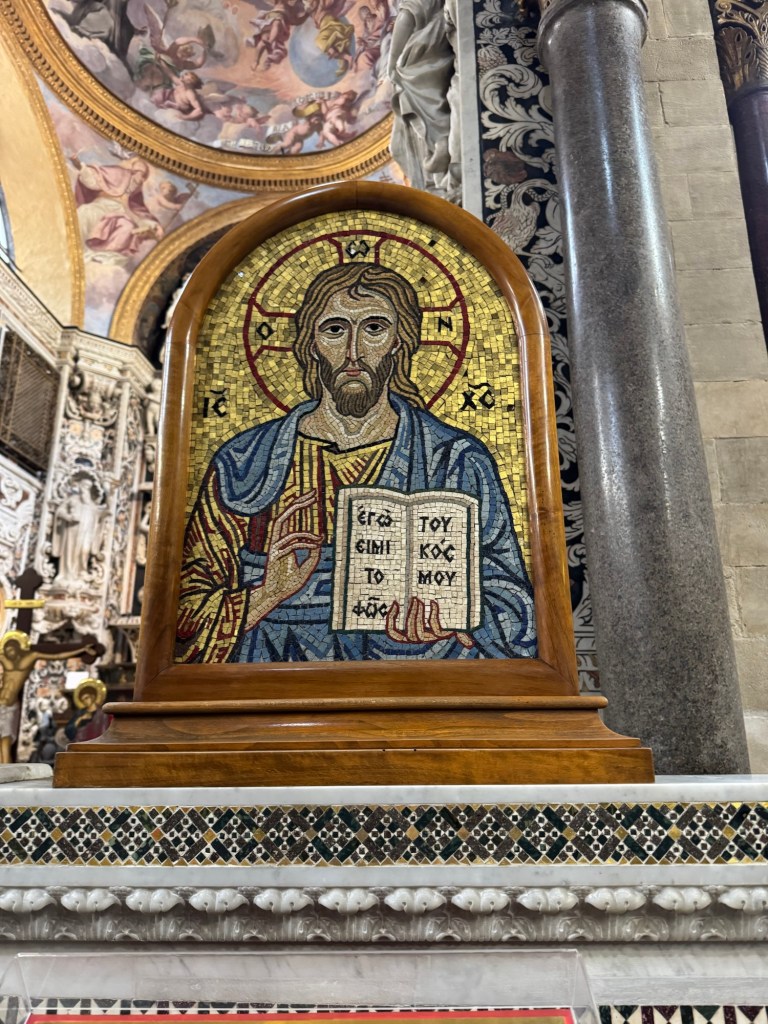
Right around the corner from this piazza you walk into another piazza called Piazza Bellini, and here you can see three outstanding churches. During our walking tour with Fabio, we went into Santa Maria dell’ Amiraglio (Church of St. Mary of the Admiral). This church was built by King Roger’s admiral, George of Antioch, in the mid-12th century. Although it is a small church, it is one of the most beautiful I have ever seen, with byzantine mosaics throughout.



The Church of St. Catherine of Alessandria, mentioned above, is also prominent in Piazza Bellini, and although we did not go into the church during our tour with Fabio, some of our fellow travelers did a tour of the church and convent and said it was well worth it! There is also a well known bakery, La Dolceria di Santa Catarina, that is inside the monastery. The cannolis are heaven sent!
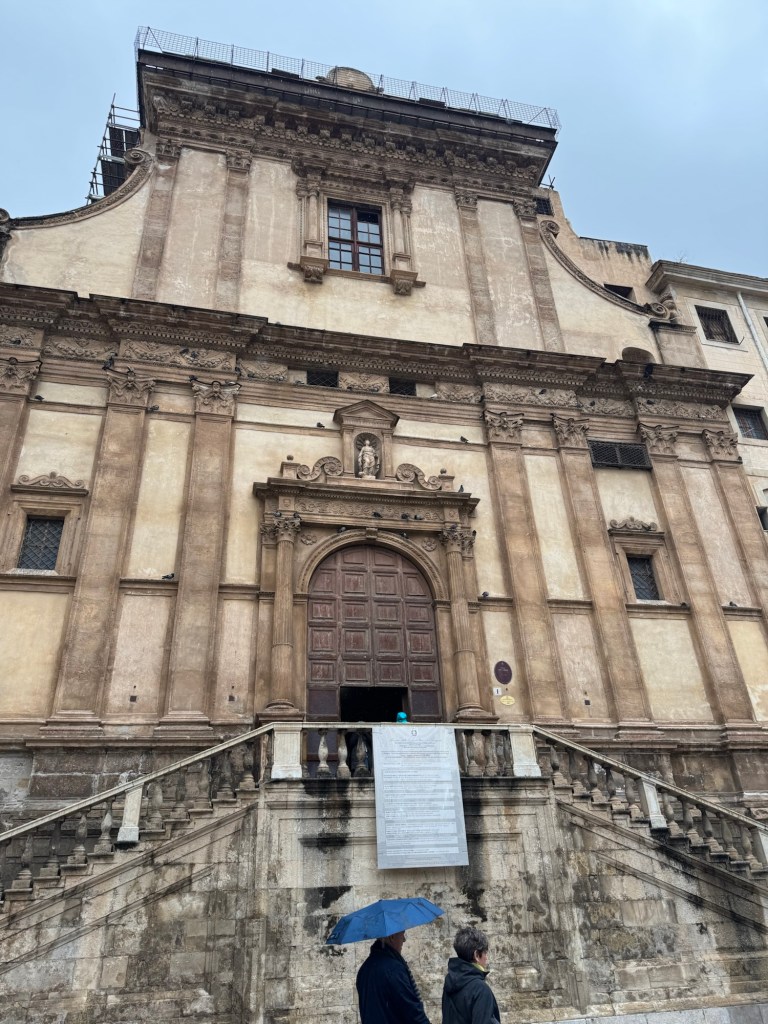
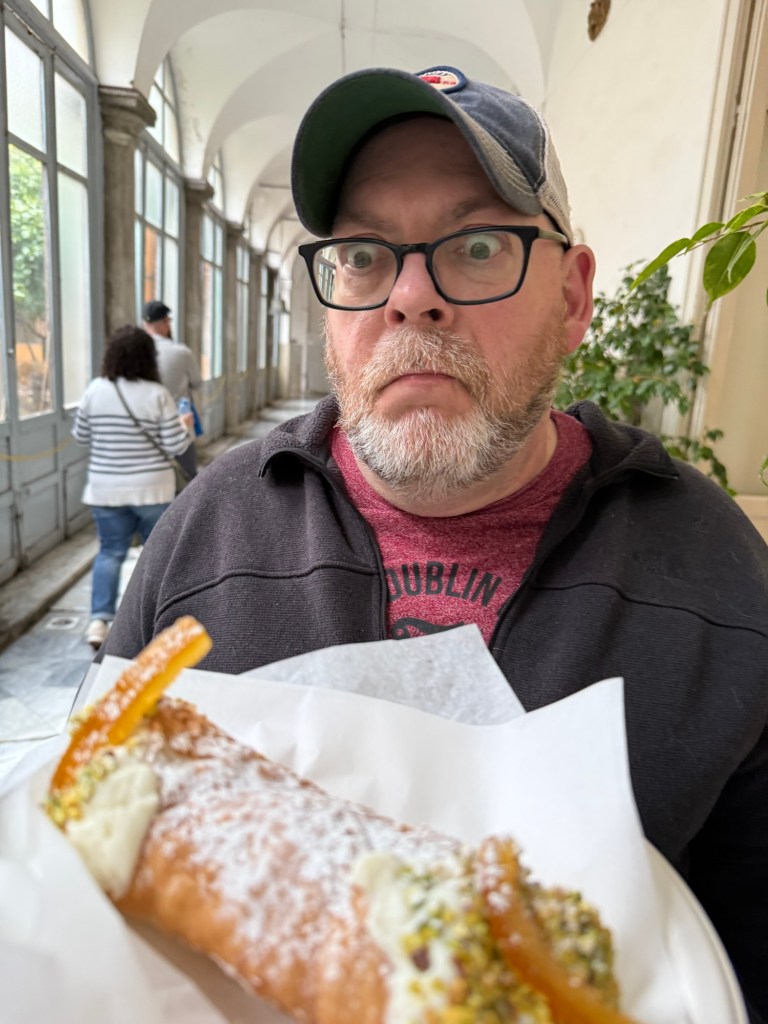
Afterwards, Fabio asked if he could take us by his friend’s store for a glass of wine – and we’ll never say no to a glass of wine! Fabio’s friend David works at Maravigghia, a hub for all things Sicilian. We were going to their reception area and storefront for a glass of wine and a chat. The wine was a delicious Vermentino. We chatted about Sicilian culture, movies, wine, food, etc. We could have stayed there all day drinking wine and talking to Fabio and David!


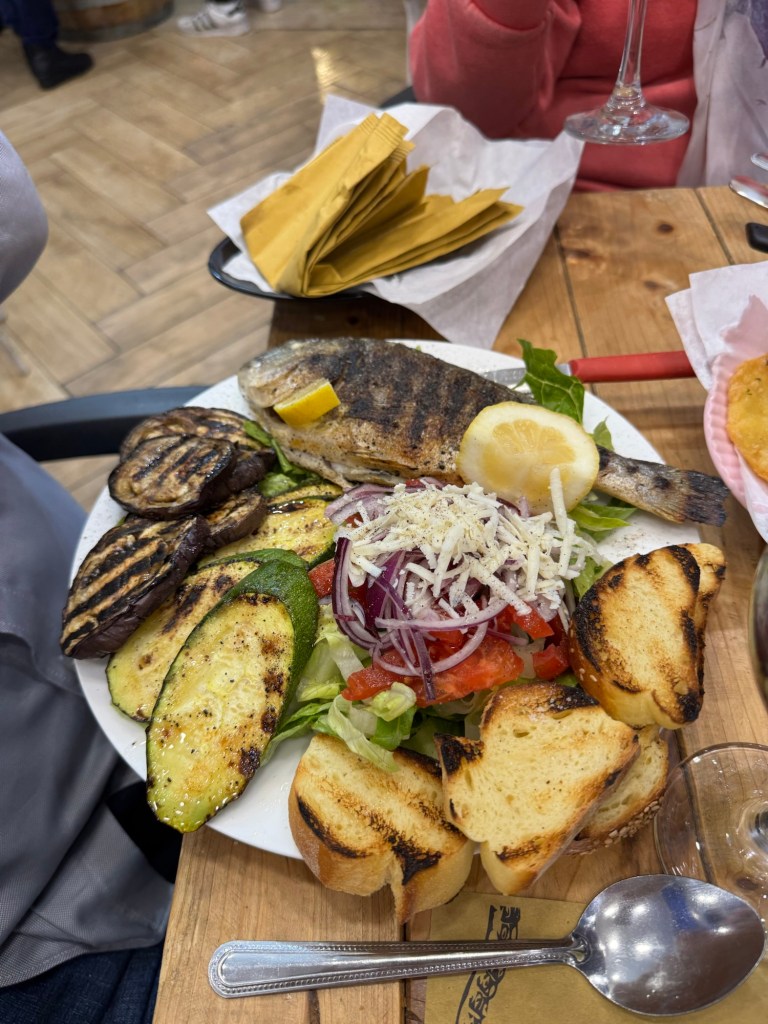
Time for lunch! We were starving, so we headed out from Maravigghia to look for a place to eat. Without realizing it, we had ventured in to La Vucciria market, Palermo’s oldest market. Since it was still raining it wasn’t crowded. The first thing I noticed was a table of old men playing cards off to the side – and I knew we would find something good and local to eat here! We kept wandering, and I saw another table full of men drinking beer and having fun – so I motioned to Mr. T, Sarah, and Susan to come take a look. Believe me, they were skeptical! But we were welcomed by a very nice man and everyone was sold. We ended up having the most delicious lunch at Alcolisti per Passion! Mr. T asked what the fish of the day was, and instead of trying to tell him, the waiter just went back in to the kitchen and brought out a plate with the raw, whole fish on it. Here it is! We still aren’t sure what kind of fish it was, but it was delicious!

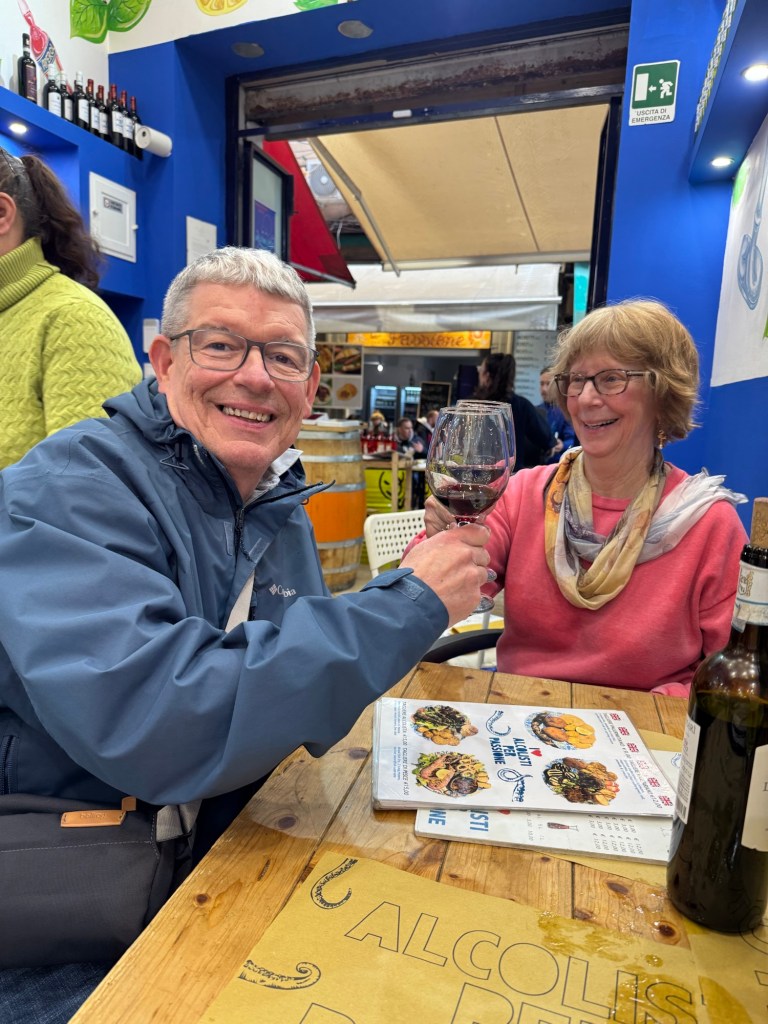
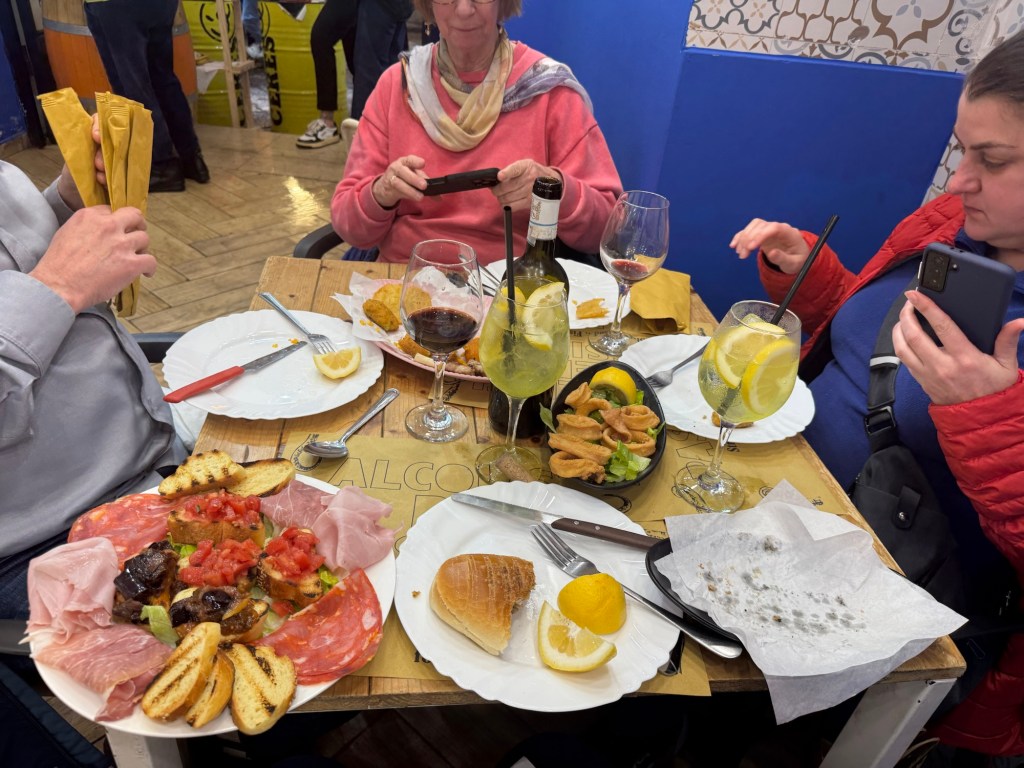
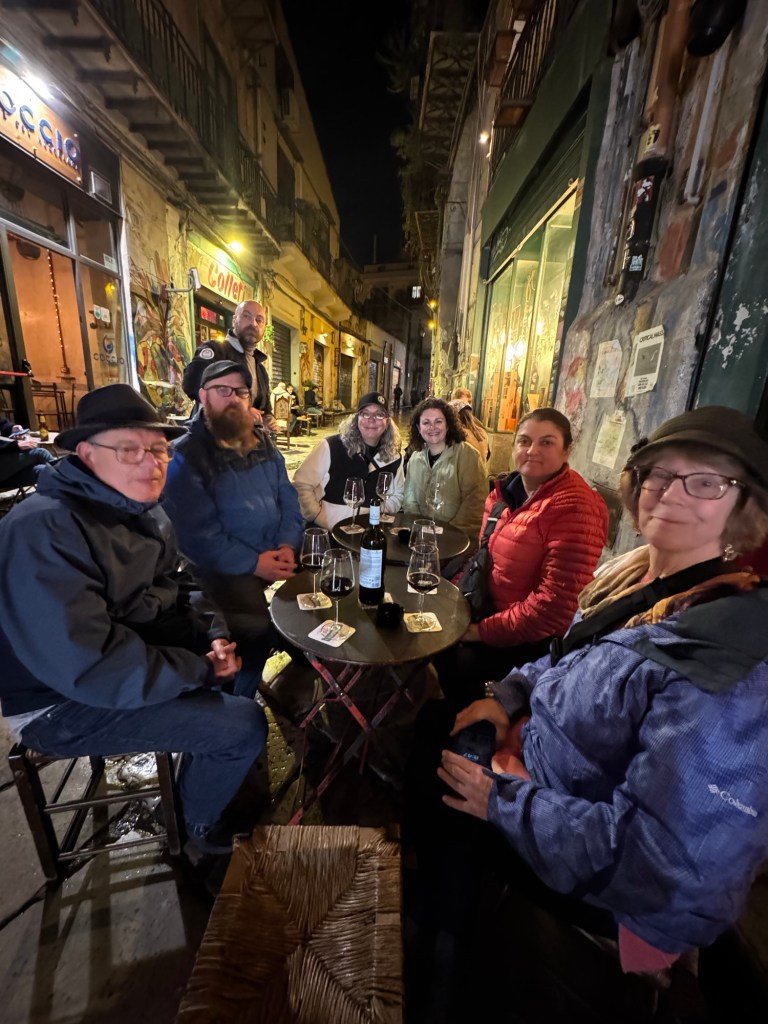
After a nap (we are in Italy after all) we met up with our fellow travelers Zach, Nancy, and Laura to do some more exploring and to find some wine. The small streets are lined with wine bars, restaurants, and food stalls.

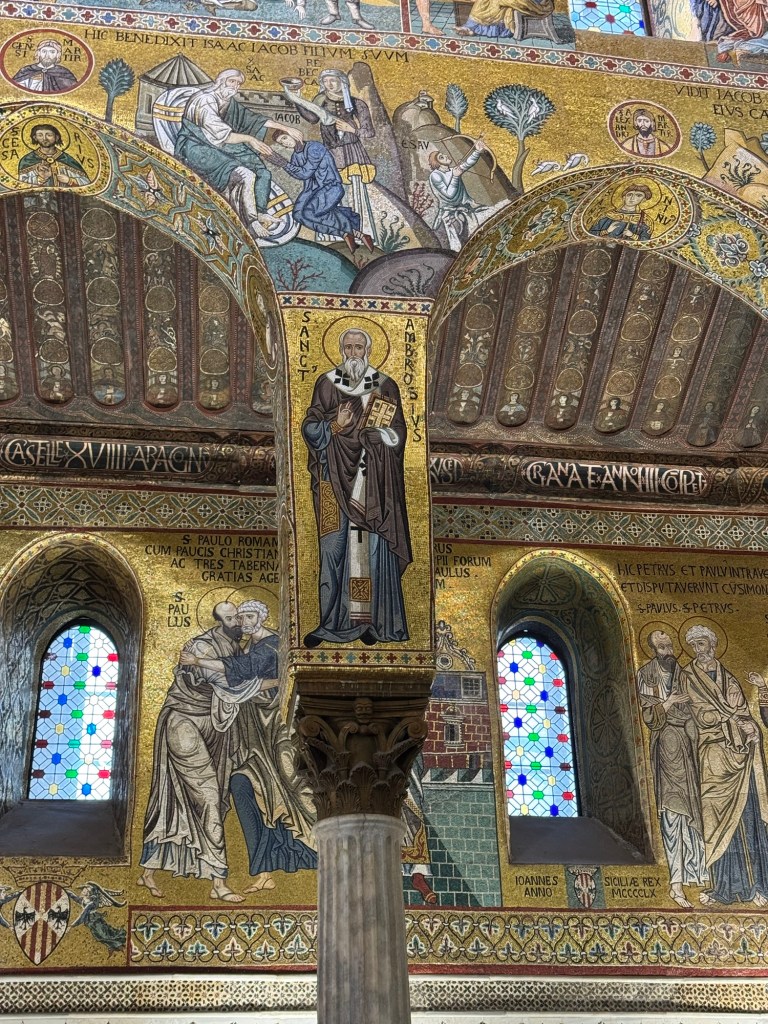
The next day we woke to a spectacular sunny day. And lots of people! Fabio was right – when it rains people stay home! We wandered back to the Palazzo dei Normanni to see the Capella Palatina, the royal chapel. The mosaics in this church are well worth a visit.


Our next stop was another church – shocking I know! We went back to Piazza Bellini to see the Chiesa di San Cataldo (Church of Saint Catald). This church was built in 1154 and is really small, especially when compared to other churches in Italy. It is also very simple and stark when compared with the other churches we have seen in Palermo with their byzantine mosaics, but nonetheless beautiful with its modest interior.


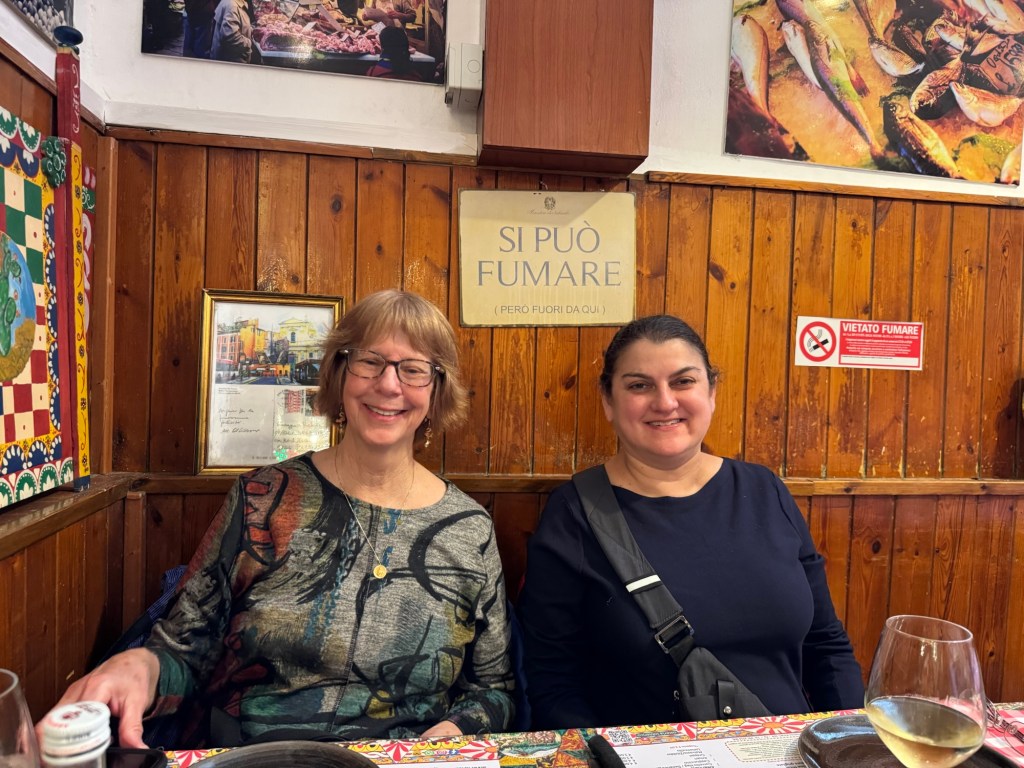
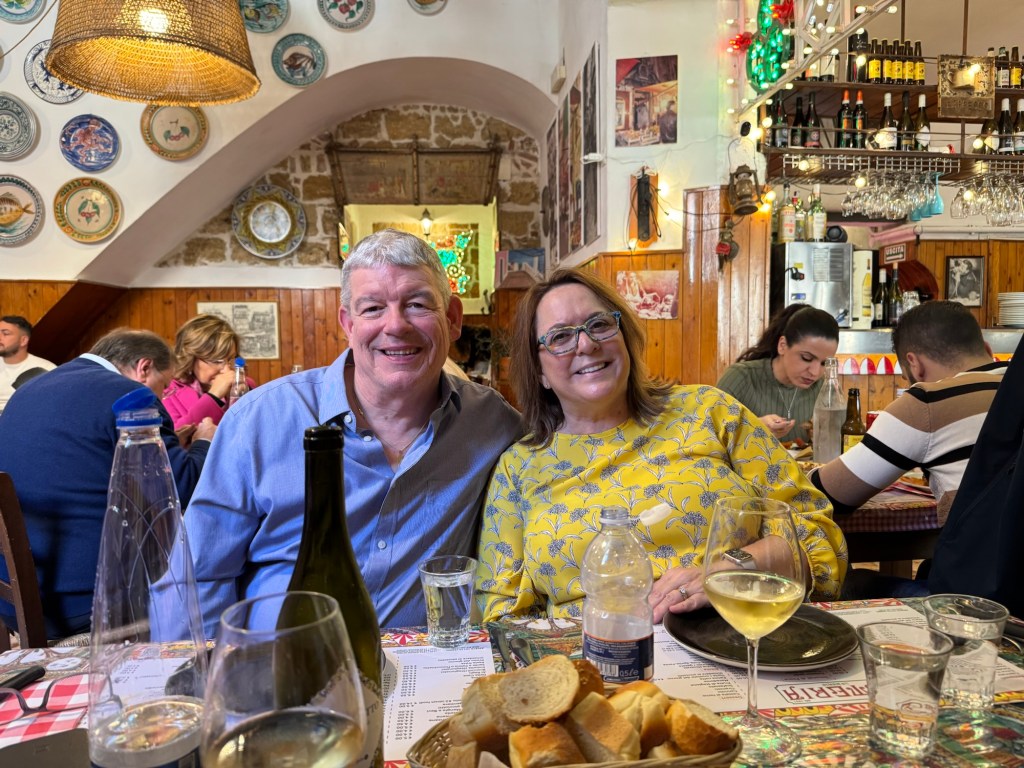
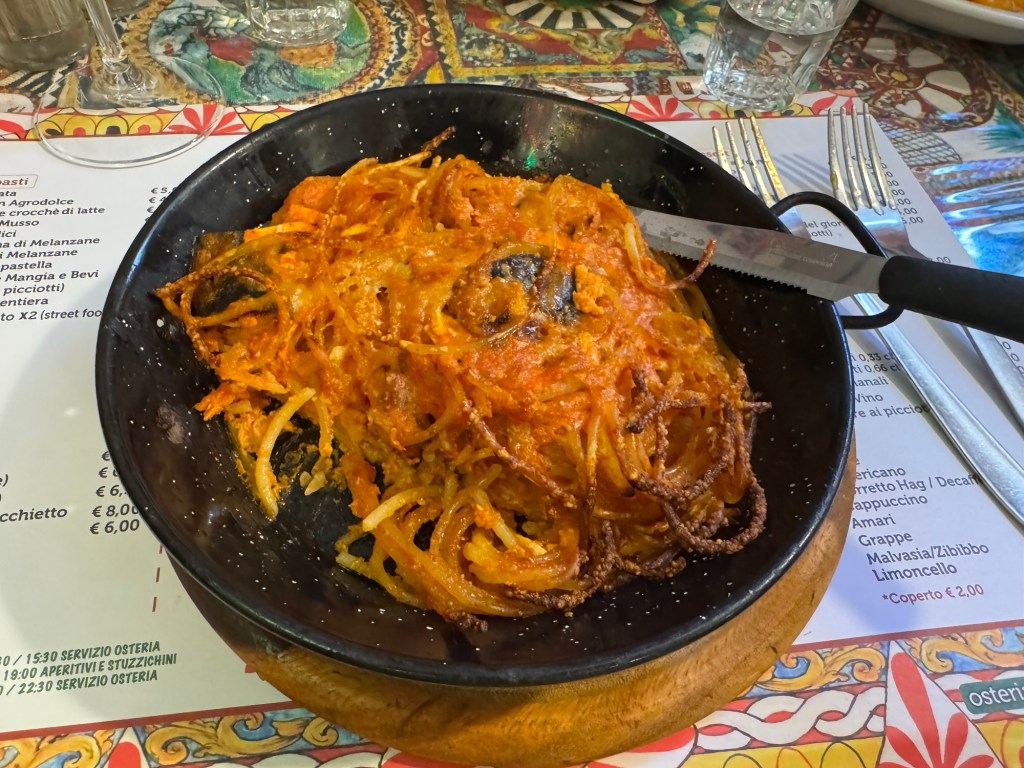
After this we did what we do best (especially Susan) – we wandered. We wanted to eat lunch at Nonna Dora, which I found out too late that you need to make reservations for weeks in advance, so we ended up going to one of the restaurants that Fabio recommended – Osteria Lo Bianco. This was such a great place! And the first place I had caponata (yum). Caponata is usually served as an appetizer (or even before the appetizer) and is made with eggplant and other goodies. I felt like every time I had it in Sicily the recipe was a little different, depending on who was making it. I could have been happy with just caponata and bread, and this is where I think I realized the Sicilians will feed you until you are stuffed to the gills.


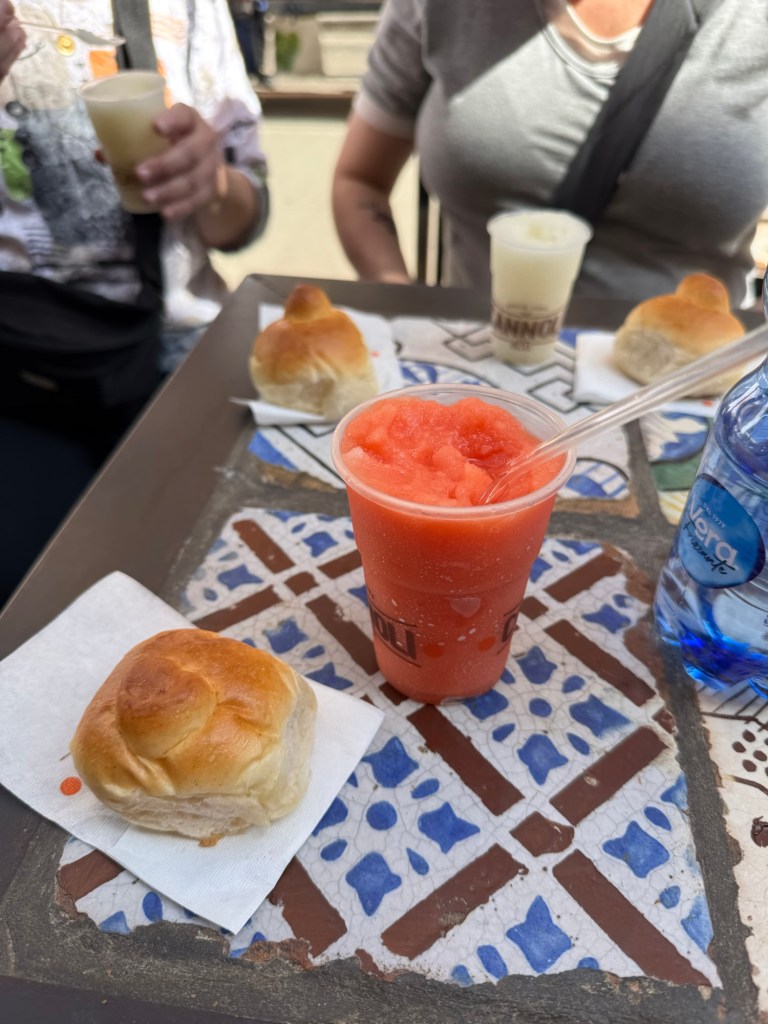
The next morning was an incredibly sunny day, and the start of our tour with Sicilian Encounters. We had some time in the morning so we walked down to the marina to see the Tyrrhenian Sea, and ended our stay in Palermo with some blood orange granita and brioche.

Our tour bus picked us up close to the hotel, and then we took off to the airport to pick up the rest of our group.
Palermo ended up being so much more than I thought it would be – the food is fantastic, and there is so much history! The people are also very friendly and proud of their heritage. There is so much there we didn’t see, and I definitely want to go back.
 Tales From The Wine Store
1 thought on “Exploring Palermo: Food, Culture, and Fun”